Why Your VO2 Max Determines How Well You Perform Under Pressure
Most men train to look better or lift more.
A smaller group trains to perform better. To be capable when it counts. To function under load, under stress, under conditions that would shut most people down.
If you’re in that second group, there’s one physiological variable that matters more than almost anything else: your aerobic capacity.
Not just for running. For everything.
What VO2 Max Actually Measures
VO2 max is the maximum amount of oxygen your body can use during intense exercise. It’s considered the single best marker of cardiovascular fitness and one of the strongest predictors of long-term health and performance.
The higher your VO2 max, the more efficiently your body can produce energy under demand. You recover faster between hard efforts. You sustain output longer before fatigue sets in. And you return to baseline quicker after stress.
That last part is the one most people miss.
VO2 max is not just a running metric. It’s a measure of how well your entire system handles demand and recovers from it. That has direct consequences for how you perform under pressure in situations that have nothing to do with a track.
What Happens to Your Body Under Stress
When you’re in a high-pressure situation, your body responds the same way it responds to physical threat.
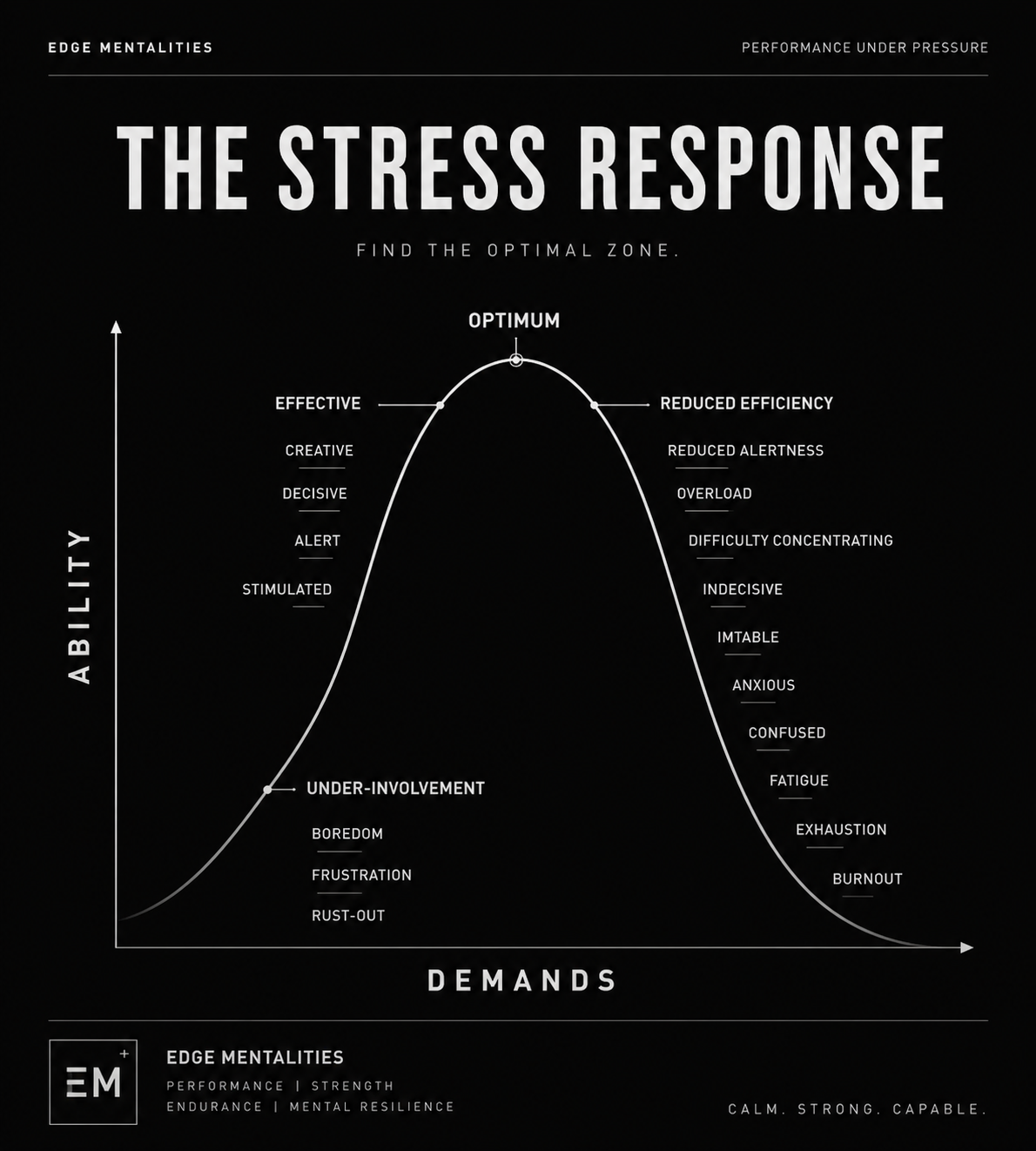
Adrenaline spikes. Heart rate climbs. Blood flow is redirected to large muscle groups. Breathing becomes faster and shallower. The prefrontal cortex, the part of the brain responsible for clear thinking, decision-making, and impulse control, receives less blood flow as the body prioritizes survival functions.
This is the stress response. It’s designed to help you in short, acute situations. But it also temporarily degrades your cognitive function, your fine motor control, and your ability to process information clearly.
The question is not whether this happens. It happens to everyone.
The question is how quickly it resolves, and how well you can still function while it’s happening.
That answer is largely determined by your cardiovascular fitness.
The Direct Link Between Aerobic Capacity and Performance Under Pressure
Decades of research on military, emergency services, and law enforcement personnel has pointed to the same finding: individuals with higher aerobic fitness show a blunted stress response, recover to baseline faster, and maintain cognitive performance better during high-demand situations.
Here is why.
A trained cardiovascular system is more efficient at managing demand.
A fit heart pumps more blood per beat. A fit respiratory system processes oxygen more efficiently. Under stress, this means your body can meet the physiological demand without going into full red-alert mode as quickly as a less conditioned system would.
Higher VO2 max means a lower resting heart rate and faster recovery.
When your resting heart rate is low and your cardiovascular system is efficient, a stressful situation that pushes you to 150 beats per minute is a smaller percentage of your maximum capacity. You have more headroom. You’re operating further from your ceiling.
Aerobic fitness builds stress tolerance at the neurological level.
Regular cardiovascular training reduces baseline cortisol, improves heart rate variability, and trains the nervous system to return to a calm state more efficiently. Over time, this means the stress response becomes less severe and shorter in duration.
Physical training is stress inoculation.
Every hard training session is a controlled dose of physiological stress. You elevate your heart rate, you push your respiratory system, you operate under fatigue. Your body and your nervous system learn to function under these conditions. The transfer to other high-stress environments is not perfect, but it is real and it is well-documented.
What a Low VO2 Max Costs You
A man with poor aerobic fitness who enters a stressful situation faces a compounding problem.
His heart rate spikes higher and faster. His stress response is more severe. His cognitive function degrades more significantly. And he takes longer to recover baseline function once the situation is over.
In a professional environment where you need to make good decisions under pressure, manage your reactions, communicate clearly, or sustain physical output over time, this is a direct performance liability.
It also compounds over time. Chronic stress on a system that lacks the aerobic base to recover from it accelerates fatigue, increases injury risk, and degrades long-term health in ways that go well beyond fitness.
The good news is that VO2 max is highly trainable. It responds to consistent aerobic work faster than almost any other fitness variable.
How to Actually Improve It
You do not need complex programming to build aerobic capacity. You need consistency and the right mix of intensities.
Zone 2 training is the foundation.
This is low-intensity, steady-state cardio at a pace where you can hold a conversation. It builds the aerobic base, improves mitochondrial density, and trains your body to use oxygen efficiently. Most of your cardio volume should be here. Running, cycling, swimming, rowing — any sustained aerobic activity works.
Aim for three to four sessions per week at 30 to 60 minutes each. This is where the long-term aerobic base is built.
High-intensity intervals build the ceiling.
One to two sessions per week at higher intensity will push your VO2 max upward. Short intervals with incomplete recovery, or longer threshold efforts, force your cardiovascular system to adapt to higher demand.
A simple example: 6 to 8 rounds of 3 minutes hard, 2 minutes easy. Done once a week on top of your zone 2 base, this will move your VO2 max meaningfully within weeks.
Consistency beats intensity.
A moderate aerobic base built over months is worth more than an aggressive training block followed by weeks of inactivity. The adaptations that matter most — heart size, stroke volume, mitochondrial density, nervous system efficiency — take time to develop and are maintained by regular training.
The Standard This Points To
Physical fitness is not separate from professional performance or personal capability. It is the base that everything else sits on.
A man who is aerobically fit thinks more clearly under pressure. He recovers faster. He sustains output longer. He handles stress without it shutting him down.
That is not a minor advantage. In the situations that matter most, it is the difference between functioning and not.
Building and maintaining that base is not optional if you take your performance seriously. It is part of the standard.
The Bottom Line
Your VO2 max is not just a fitness number.
It is a measure of how well your system handles demand and recovers from it. Under pressure, that matters more than almost any other physical variable.
Train your aerobic base. Protect your recovery. Build the capacity to function when it counts.
That is what physical preparation is actually for.
Based on research in exercise physiology and stress response across military and tactical populations.
Posted by Edge Mentalities | edgementalities.com